
Critical Thinking — The Question Nobody Taught Them to Ask

My son said something at dinner last Tuesday with the kind of confidence that’s hard to argue with.
A statistic. A clear claim. Delivered the way he delivers things he’s certain about.
I asked where he heard it.
He shrugged. “I don’t know. It’s just... known.”
That phrase stopped me. It’s just known. Not “I read it.” Not “my teacher said.” Not even “I saw it somewhere.” Just — known. As if the information had always existed, floating free of any source, immune to doubt.
He’s fifteen. He’s sharp. He does well in school.
And he had no idea that “it’s just known” is the most dangerous kind of knowing there is.
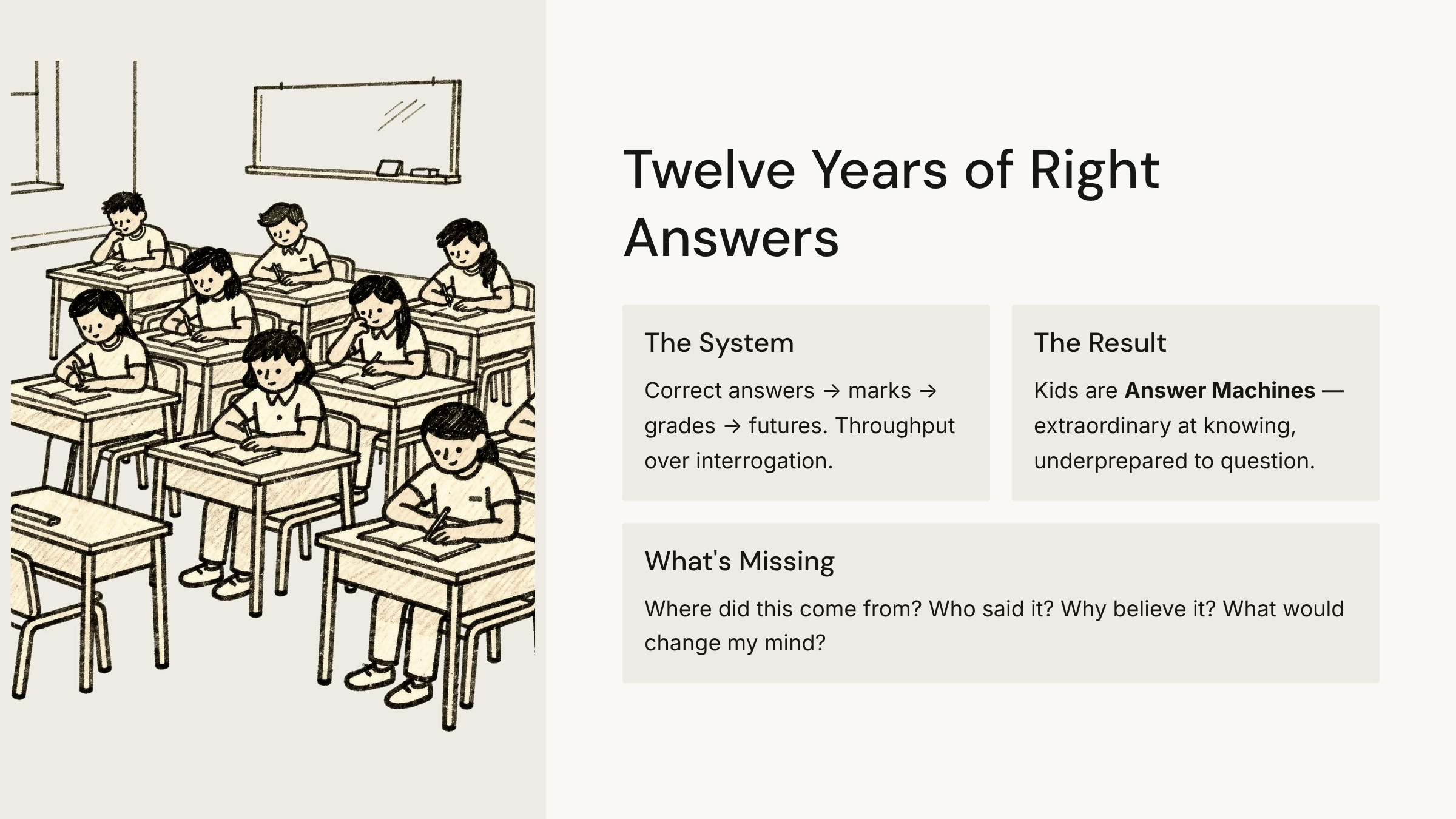
Schools have spent twelve years teaching kids to find the right answer. The entire architecture of formal education is built around it — correct answers get marks, marks become grades, grades become futures. What’s almost never taught is the more important question: how do you know that answer is right?
This isn’t a criticism of teachers. It’s a structural problem. You can’t run a classroom of thirty children and reward every kid who says “but how do we know?” You’d never finish the lesson. So the system, quite reasonably, optimises for throughput: deliver information, test recall, move on.
The result is a generation of children who are extraordinarily good at knowing things — and remarkably underprepared to interrogate what they know.
My son isn’t unusual. Most fifteen-year-olds have been trained, twelve years deep, to be Answer Machines. Feed in a question, output the correct response. What they haven’t been trained to do is pause before the output and ask:
Where did this come from?
Who said it?
Why should I believe it?
What would change my mind?
Those four questions are the entire infrastructure of critical thinking.
And they are almost never taught.
Here’s what I’ve come to understand: critical thinking isn’t a subject. It’s a stance.
It’s not something you learn in a specific class and apply later. It’s a way of moving through information — a posture of productive scepticism that asks not just what, but why, who, and what else.
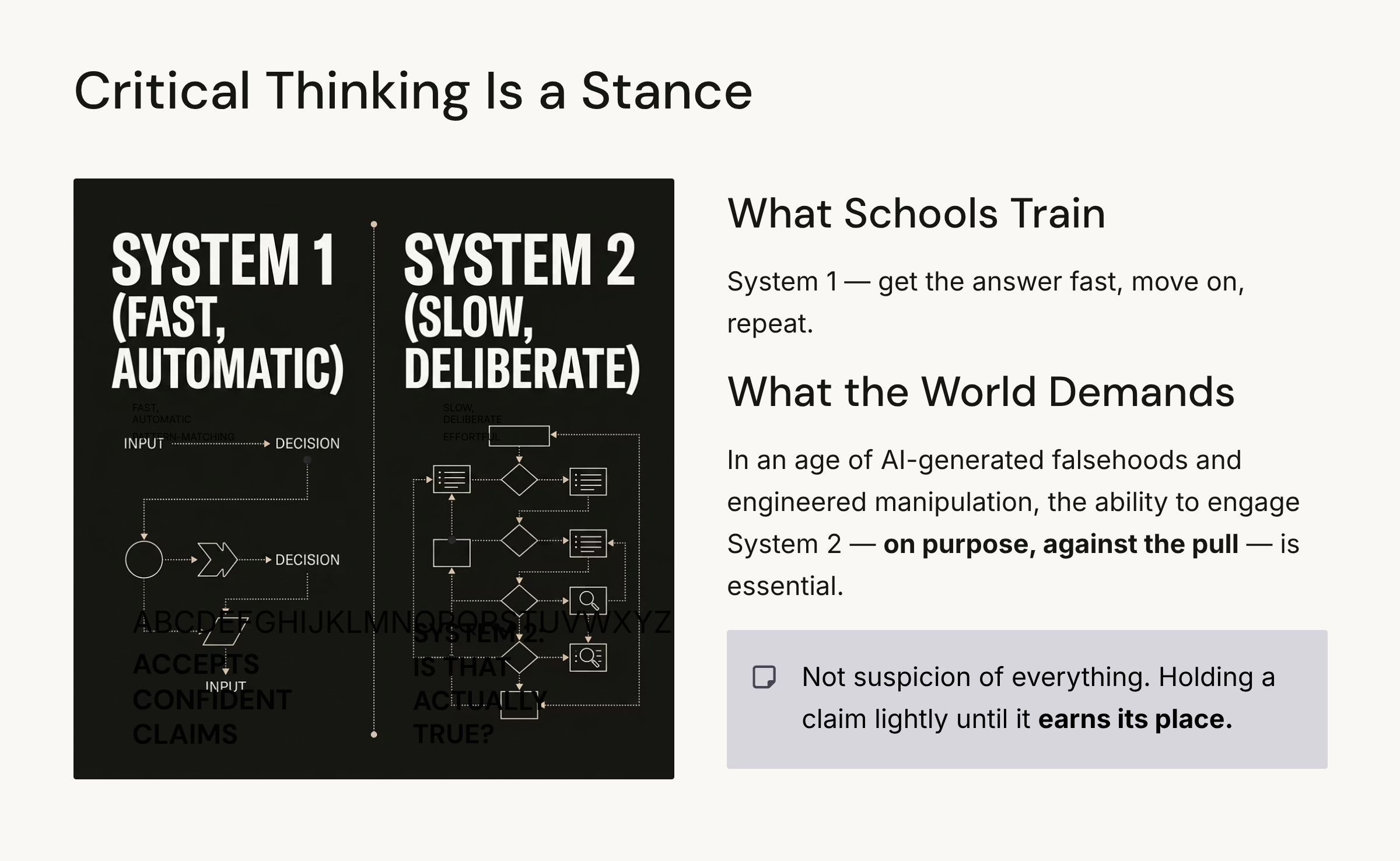
The psychologist Daniel Kahneman described two modes of thought. System 1 is fast, automatic, pattern-matching. It’s the part of your brain that hears a confident claim and accepts it because confidence feels like evidence. System 2 is slow, deliberate, effortful. It’s the part that pauses and says: wait — is that actually true?
Schools train System 1 almost exclusively. Get the answer fast. Move on. Repeat.
What the world increasingly demands — in an age where AI can generate convincing falsehoods at scale, where social media is engineered to bypass slow thinking, where every company and politician and advertiser has learned to package manipulation as information — is the ability to engage System 2. On purpose. Against the pull.
This isn’t about teaching kids to be suspicious of everything. That’s paranoia, not thinking. It’s about teaching them to hold a claim lightly until it earns its place. To ask for evidence before they share the conclusion. To know the difference between a fact and an opinion wearing a fact’s clothes.
That skill starts with a single question most of us have never consistently modelled.
How do you know?
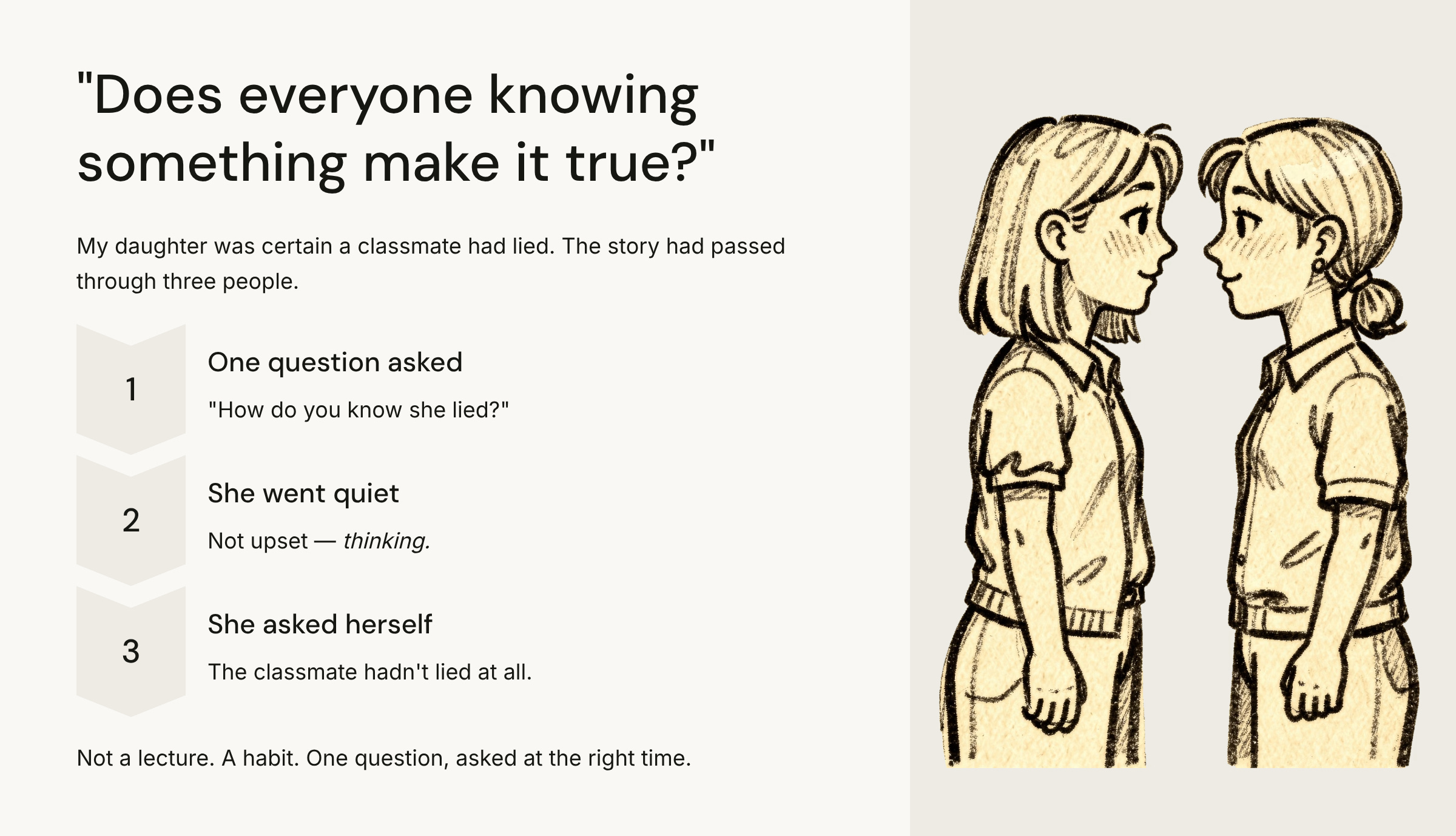
A few weeks ago, my daughter came home certain that a classmate had lied to her. She’d heard it from two friends, who’d heard it from someone else.
Instead of agreeing or disagreeing, I asked: “How do you know she lied?”
“Because everyone says so.”
“Does everyone knowing something make it true?”
She went quiet. Not upset — thinking. You could almost see the machinery slow down.
She came back an hour later. “I’m going to ask her myself.”
She did. The story had mutated three times through the chain. Her classmate hadn’t lied at all.
Nothing about that moment required a lecture. It required one question, asked at the right time, by someone she trusted. That’s the entry point for this skill. Not a lesson. A habit. A single question repeated enough times that eventually — eventually — they start asking it themselves.
This week, we’re unpacking what critical thinking actually looks like at different ages. Because a five-year-old and a fifteen-year-old need completely different entry points, and most parents conflate the two.
On Wednesday, you’ll get age-by-age implementation: the specific moments, questions, and activities that build this skill without turning every dinner into a debate club.
On Friday, a seven-day plan — and a printable — designed to make the first week of this feel like a beginning, not a project.
Before Wednesday arrives: think about the last time someone told you something and you accepted it without asking how they knew. Not your child. You.
If it happened today, you’re not alone. That’s exactly where we start.