
Goal Setting & Systems — Why Good Intentions Die on a Wednesday
Your child isn't lacking motivation. They're lacking something far more practical.

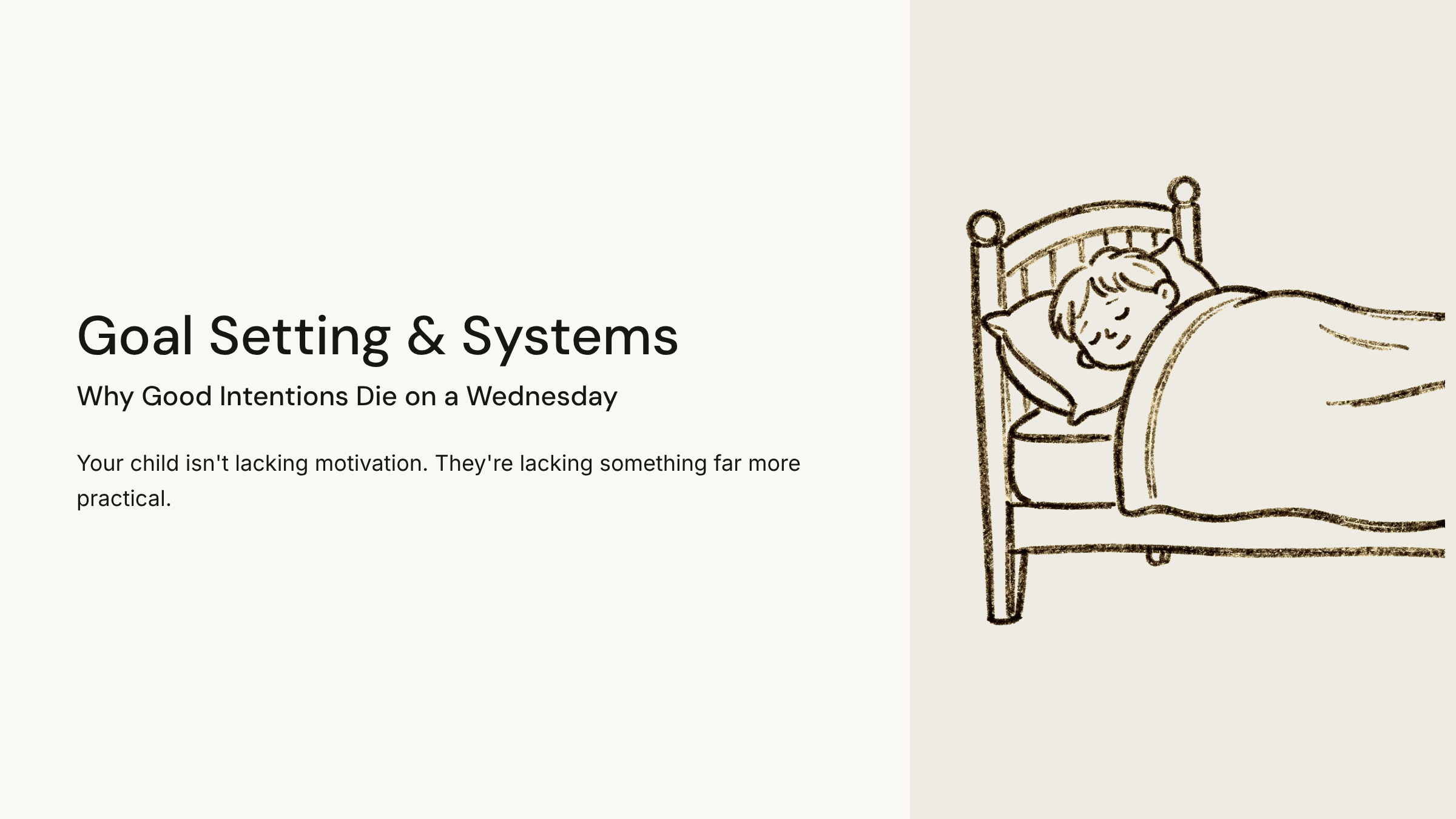
About ten days after the conversation with my son — the one where he decided he was willing to get up earlier some mornings and move — I walked past his room at 7am on a Wednesday.
He was still in bed.
I didn’t say anything. I made a coffee and stood in the kitchen thinking about it.
He wasn’t lazy. He’d been up early on Saturday. Sunday too. He’d done something Monday. But by Wednesday, something had quietly collapsed — and it wasn’t his desire to follow through. When I’d asked him about the goal, he still meant it. He still wanted it.
The problem wasn’t motivation.
The problem was that every single morning, he had to decide again.
We’ve built an entire cultural mythology around motivation. We talk about it like it’s a fuel source — something you either have or you don’t, something you can top up with the right podcast or the right quote or the right conversation with your dad on a Sunday evening.
But motivated people quit all the time.
Every January, genuinely motivated people set genuinely real goals and abandon them by February — not because they didn’t want it, not because they lacked discipline, but because motivation is not a system. It’s a feeling. And feelings change by Wednesday.
The research on behaviour change is consistent and slightly uncomfortable: the people who follow through on their goals aren’t more motivated than the people who don’t. They’ve simply arranged their lives so that the behaviour happens almost automatically. The decision was made once. Not daily.
We don’t teach children this. We teach them to want things more. To try harder. To be more disciplined. And when they still quit — because they will, because everyone does when they’re relying on motivation alone — we let them conclude that the problem is them.
It isn’t. The problem is that nobody gave them a system.
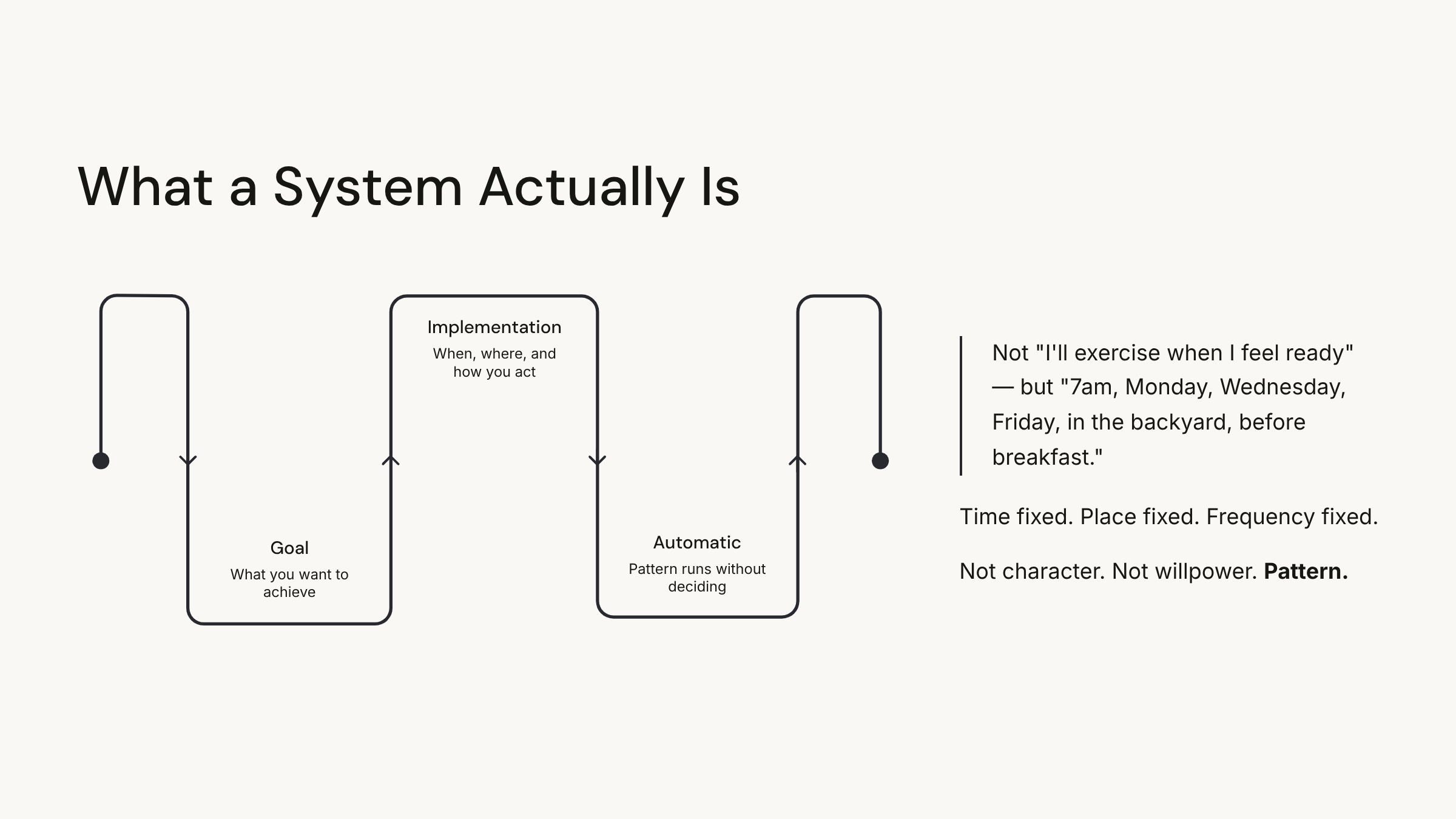
A system is a decision made in advance.
Not I’ll exercise when I feel ready — which, on a Wednesday morning with a warm bed and a full day ahead, means never. But I exercise at 7am on Monday, Wednesday, and Friday, in the backyard, before breakfast. The time is fixed. The place is fixed. The frequency is fixed. There is nothing to decide on Wednesday morning except whether to stand up — and even that gets easier once the pattern has been repeated enough times that it stops feeling like a choice.
This is what habit researchers call implementation intention. What it means in plain language is: the goal tells you what you want. The system tells you exactly when and where and how you’re going to do it. Without the system, the goal is an intention floating in time, waiting for the right conditions to act on it. Those conditions rarely arrive on schedule.
The shift from goal to system is not complicated. But it is specific. Vague systems — I’ll do it in the mornings — don’t work. The brain needs a clear trigger: a time, a place, a cue that says now. When the trigger arrives, the decision is already made. There’s nothing to motivate. There’s nothing to discipline. There’s just the next step in a pattern that already exists.
That’s the difference. Not character. Not willpower. Pattern.
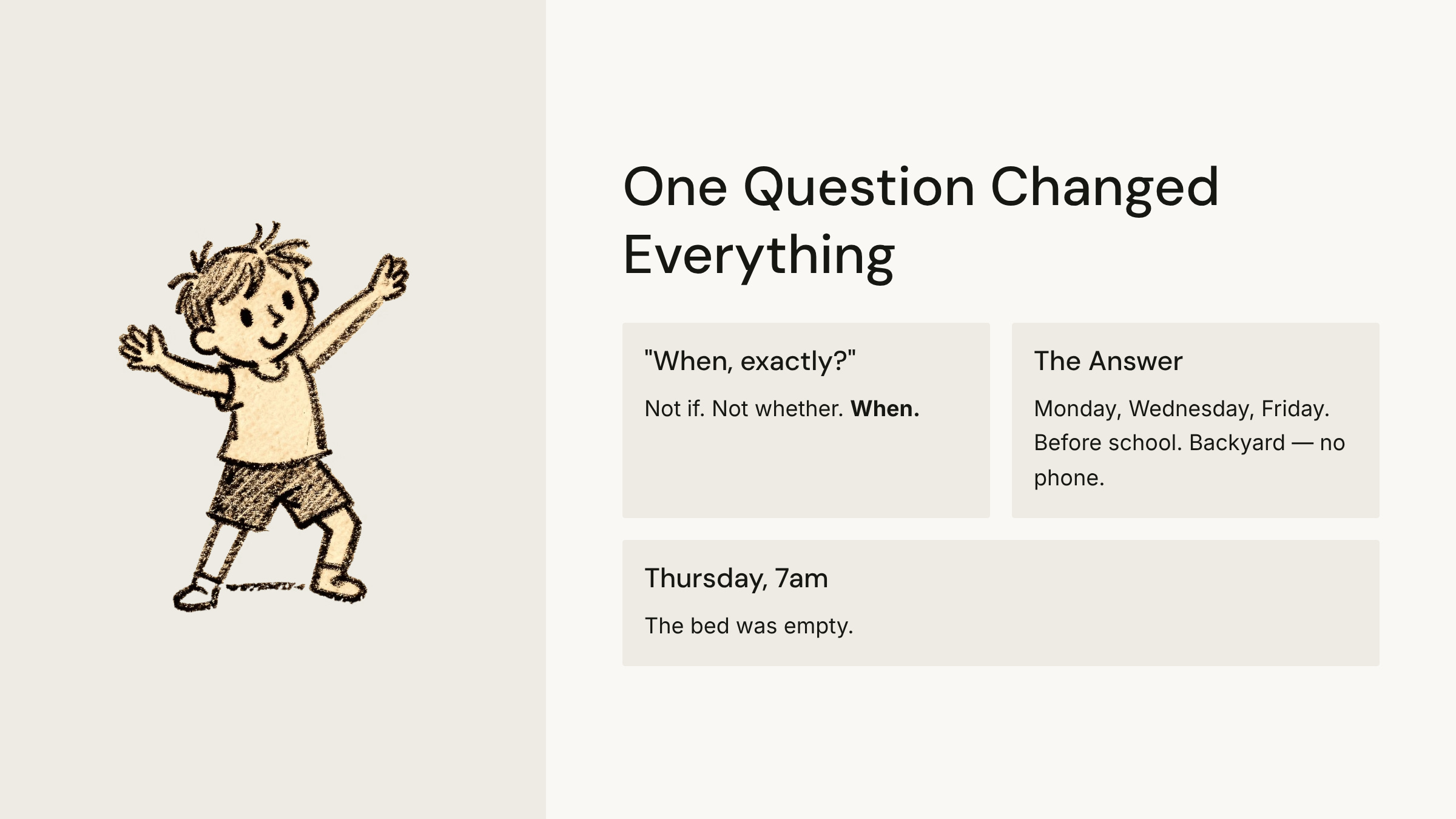
I went back to my son that evening. Not to ask why he’d missed Wednesday — that conversation never helps. I asked one question instead:
“When, exactly, are you going to do this?”
Not if. Not whether. When.
He thought about it properly this time. Landed on Monday, Wednesday, Friday. Before school. In the backyard because his phone wouldn’t be there to distract him.
He’d moved from I want to get fit to I’ve decided to do this — and now to here is exactly when and where it happens. Three conversations. Three weeks apart. Each one a level deeper.
On Thursday morning I walked past his room at 7am.
The bed was empty.
The goal was the same. The motivation was the same. What changed was the structure around it — and the structure is something any parent can help build, for any child, at any age.
Wednesday breaks down exactly how to do that: how to take a real goal and design a system around it that doesn’t depend on how your child feels on a given morning. What it looks like at five, and what it looks like at fifteen.
Friday gives you the seven-day plan to install one system — just one — before the week is out.
One system, running quietly in the background, is worth a hundred goals written in a notebook and forgotten.