
The Curiosity Framework: Exact Scripts, Age-by-Age — and What to Do When Your Child Has Switched Off Completely
Wednesday Implementation Guide: The practical system for building question-asking as a daily habit

Monday, I told you about my daughter’s water cycle moment — the school project that was technically perfect and completely curiosity-free. And I told you the questions weren’t gone. They were just waiting for permission.
Today we’re building the permission structure.
Because here’s what I’ve found, both with my own kids and through this community: knowing that curiosity matters isn’t enough. Most of us already believe it. What we need is the when, the how, and the what exactly do I say — especially when our child looks at us blankly and says “I don’t know” to every question we ask, or worse, “I don’t care.”
This is the Curiosity Framework. It’s what I use with my daughter. It’s what the research consistently backs. And it works even — especially — for the child who seems to have fully checked out.
Why “Just Ask More Questions” Doesn’t Work
Before we get into the framework, I want to address something that trips almost every parent up.
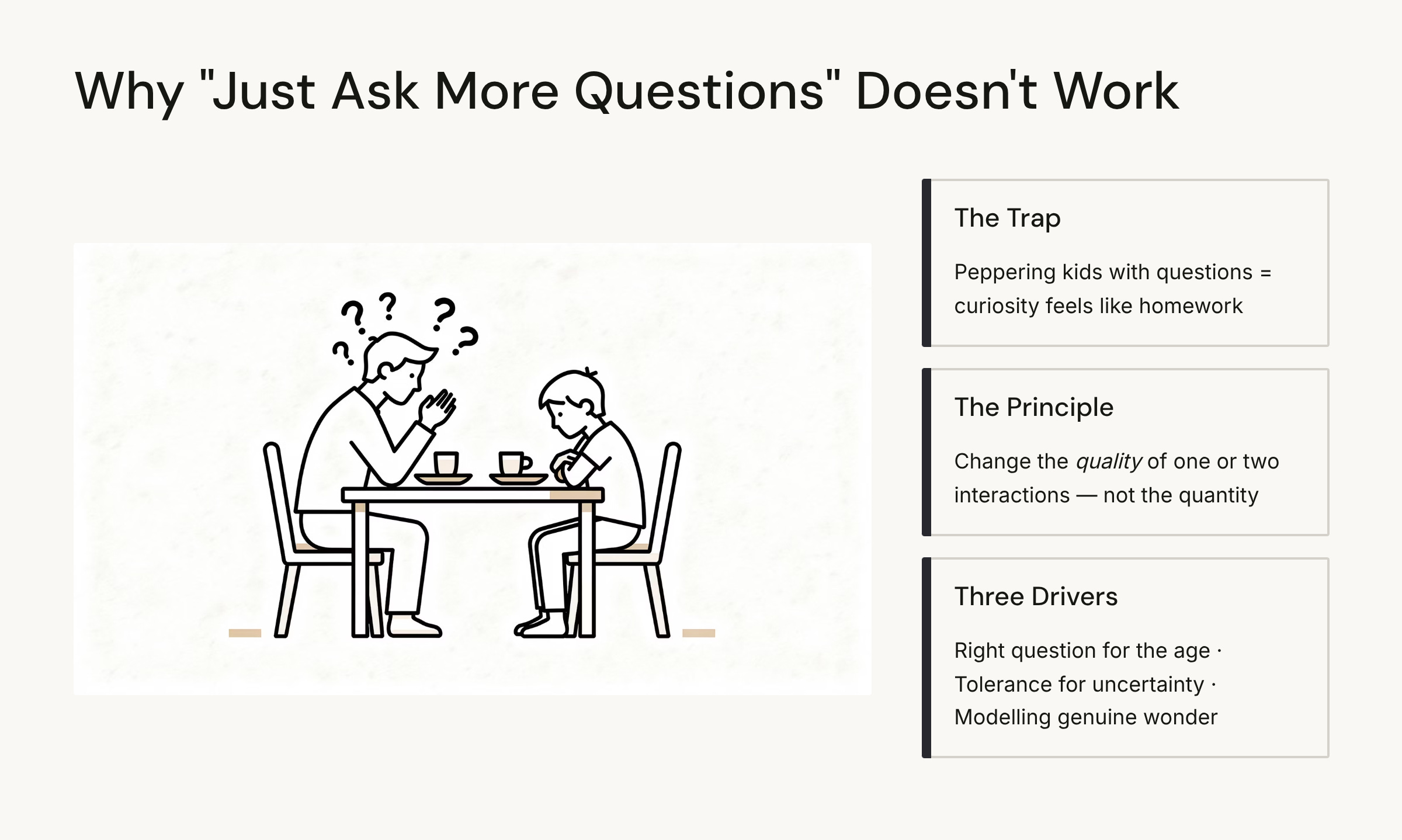
When we first try to encourage curiosity, we tend to do one of two things: we pepper our kids with questions (”Why do you think that happens? What do you think we could find out? Isn’t that interesting?”) or we turn every moment into a learning exercise. Both of these produce the same result: a child who learns to dread curiosity conversations because they feel like homework in disguise.
The Curiosity Framework works on a different principle. Instead of adding more questions to your child’s day, it’s about changing the quality of one or two interactions — and making sure those interactions feel like discovery, not interrogation.
Three things drive it: the right question for the right developmental stage, a genuine tolerance for sitting in uncertainty together, and modelling that you — the adult — find the world genuinely puzzling and interesting.
Let’s go through each.
Part One: The Right Question at the Right Age
Not all curiosity questions land the same way across different ages. A question that lights up a seven-year-old will make a twelve-year-old roll their eyes. Here’s what actually works, age by age.
Ages 5–7: The “Scientist Guess” Question
At this age, children are natural hypothesisers — they love making guesses. The problem is we often correct the guess immediately, which shuts down the wondering.
The Scientist Guess question keeps the loop open.
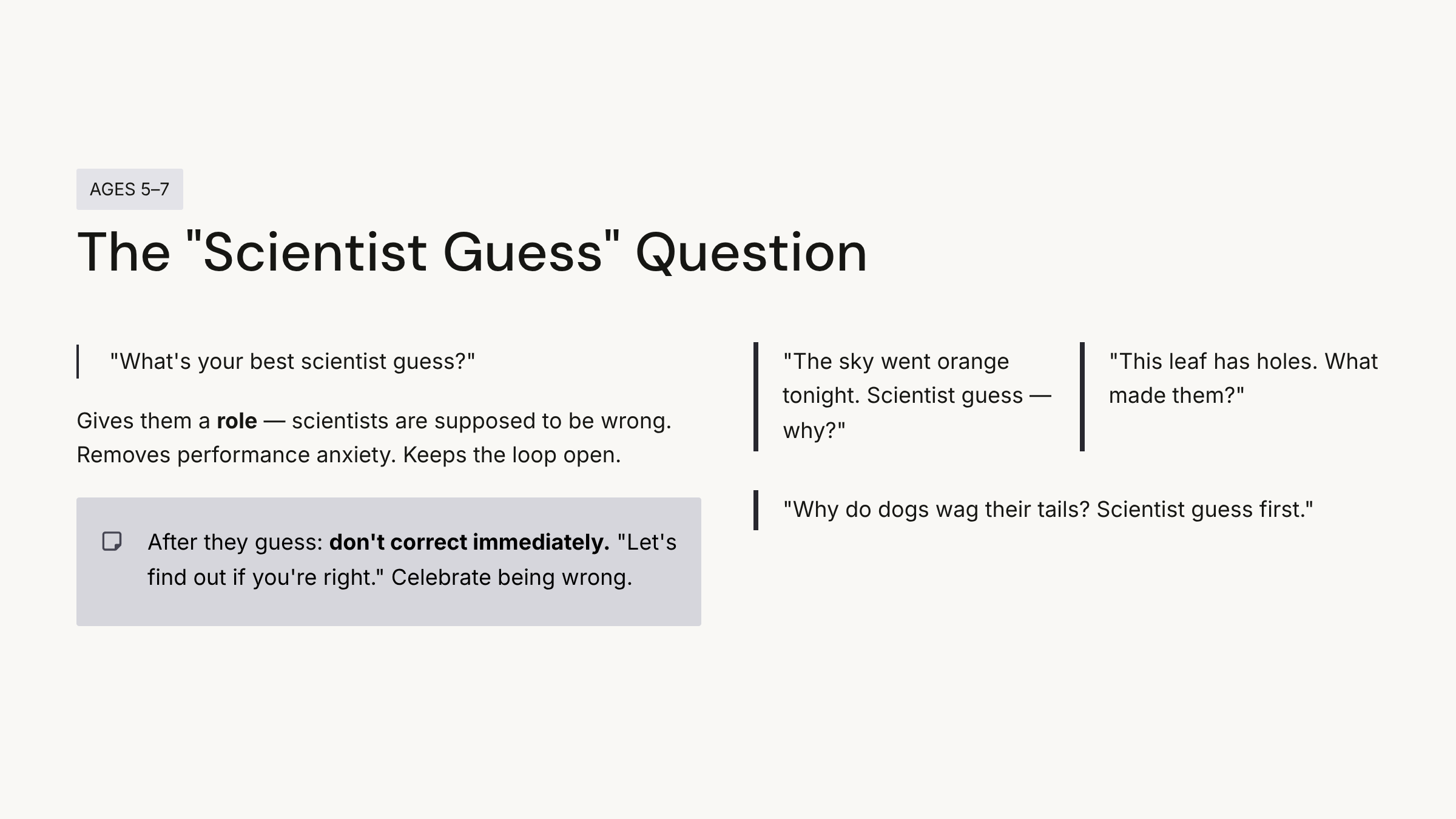
The formula: “What’s your best scientist guess?”
This is different from “What do you think?” because it gives them a role — scientist — which gives them permission to be wrong. Scientists are supposed to make guesses that turn out to be incorrect. It removes the performance anxiety.
In practice:
“The sky went really orange tonight. What’s your best scientist guess for why?”
“This leaf has holes in it. Scientist guess — what made them?”
“Why do you think dogs wag their tails? Scientist guess first, then we’ll check.”
The key: after they guess, don’t correct them immediately. Say “Interesting. Let’s find out if you’re right.” Then look it up together. When they’re wrong — celebrate it. “You were wrong AND you got closer to the real answer. That’s exactly what scientists do.”