
The Praise That Stopped Working

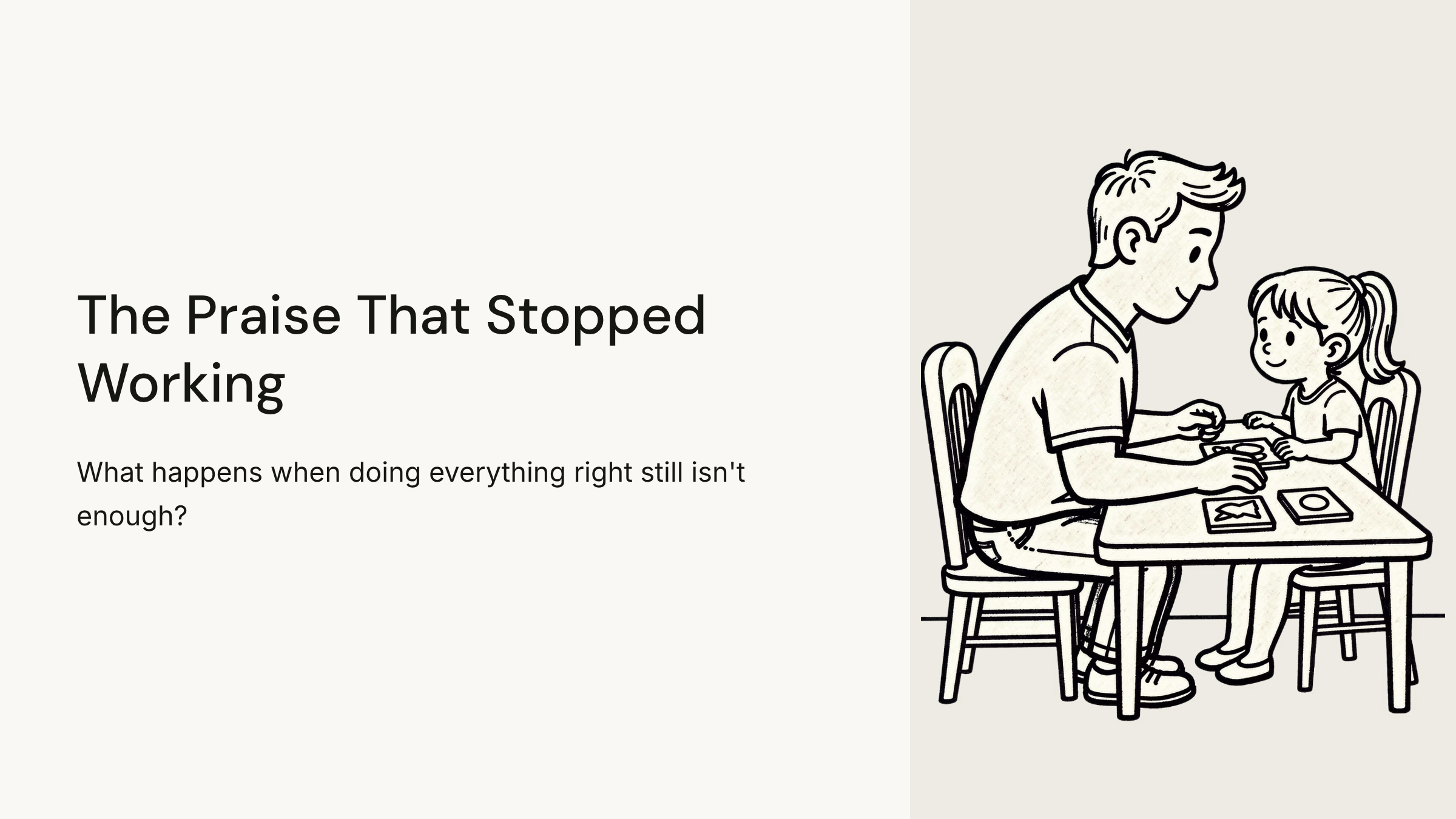
My daughter got four words wrong on her spelling retest last week. Same four words as the first time.
We’d drilled them every night. Flashcards at breakfast. I quizzed her in the car. So when she showed me the paper, I did what I’ve been doing since last month’s post — I skipped straight past the score. “I’m so proud of how hard you worked on this,” I said.
She looked at the paper, then at me. “Dad. I still failed.”
I’d done everything the growth mindset article told me to do. Praised the effort, not the outcome. And it landed like nothing.
Here’s the question that’s been sitting with me since: what if the thing we fixed last month has its own trap — and we just walked straight into it?
The uncomfortable truth
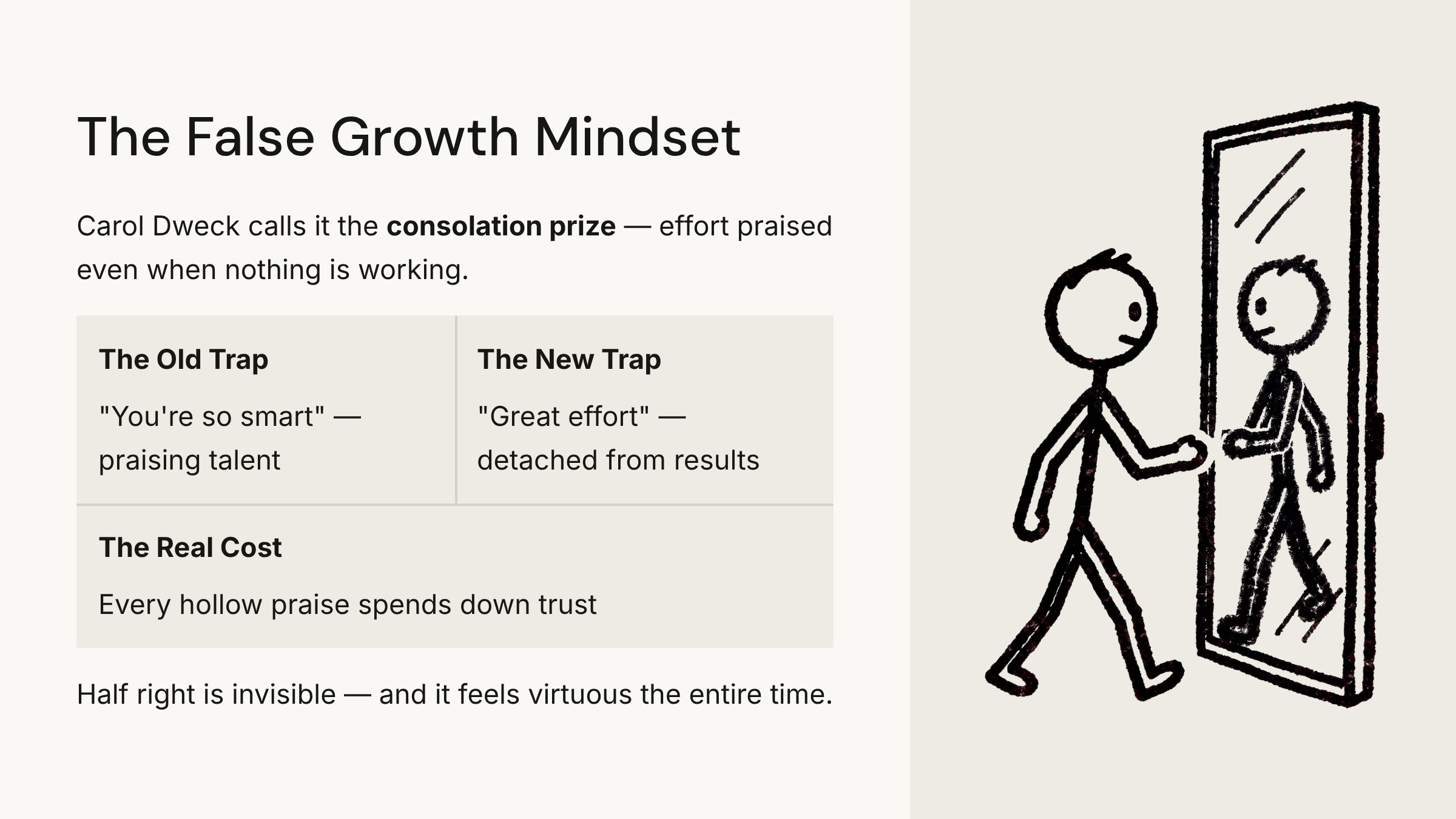
Carol Dweck — the Stanford researcher who built the entire growth mindset idea — has spent the last several years worried about something she didn’t see coming. She calls it the false growth mindset, and it’s not the fixed mindset in disguise. It’s worse, because it feels like you’re doing everything right.
It works like this: a parent learns that praising talent (”you’re so smart”) backfires, so they switch to praising effort (”you worked so hard”). Good instinct. Except somewhere along the way, “effort” quietly detached from “did it work.” Now a kid can try hard, fail, try the exact same failing approach again, and still get a standing ovation — because the only thing being measured is how hard they seemed to be trying.
Dweck has a name for what this becomes: the consolation prize. Praise for the kids who most need real help, dressed up as encouragement so nobody — parent or child — has to sit with the fact that something isn’t working.
Here’s the part that stings a little: this isn’t lazy parenting. It’s careful parenting that overcorrected. You read the research. You stopped calling your kid smart. You started saying “great effort” instead — and it felt like progress, because it was better than what you were doing before. The trap isn’t that you got it wrong. It’s that you got it half right, and half right is invisible. A parent praising talent knows, deep down, they’re doing something a little risky. A parent praising empty effort feels virtuous the entire time.
And kids know the difference even when we don’t. My daughter didn’t need a psychology paper to clock the gap between “you tried hard” and “you got it right.” She needed one sentence, and she saw straight through it. Every time we praise effort that produced nothing, we’re not just failing to help — we’re spending down trust. The next time we say “I’m proud of you,” it counts for a little less. Say it enough times attached to nothing, and eventually the words become background noise, the way “how was school” gets answered with “fine” — a reflex, not a real exchange.
The deeper insight
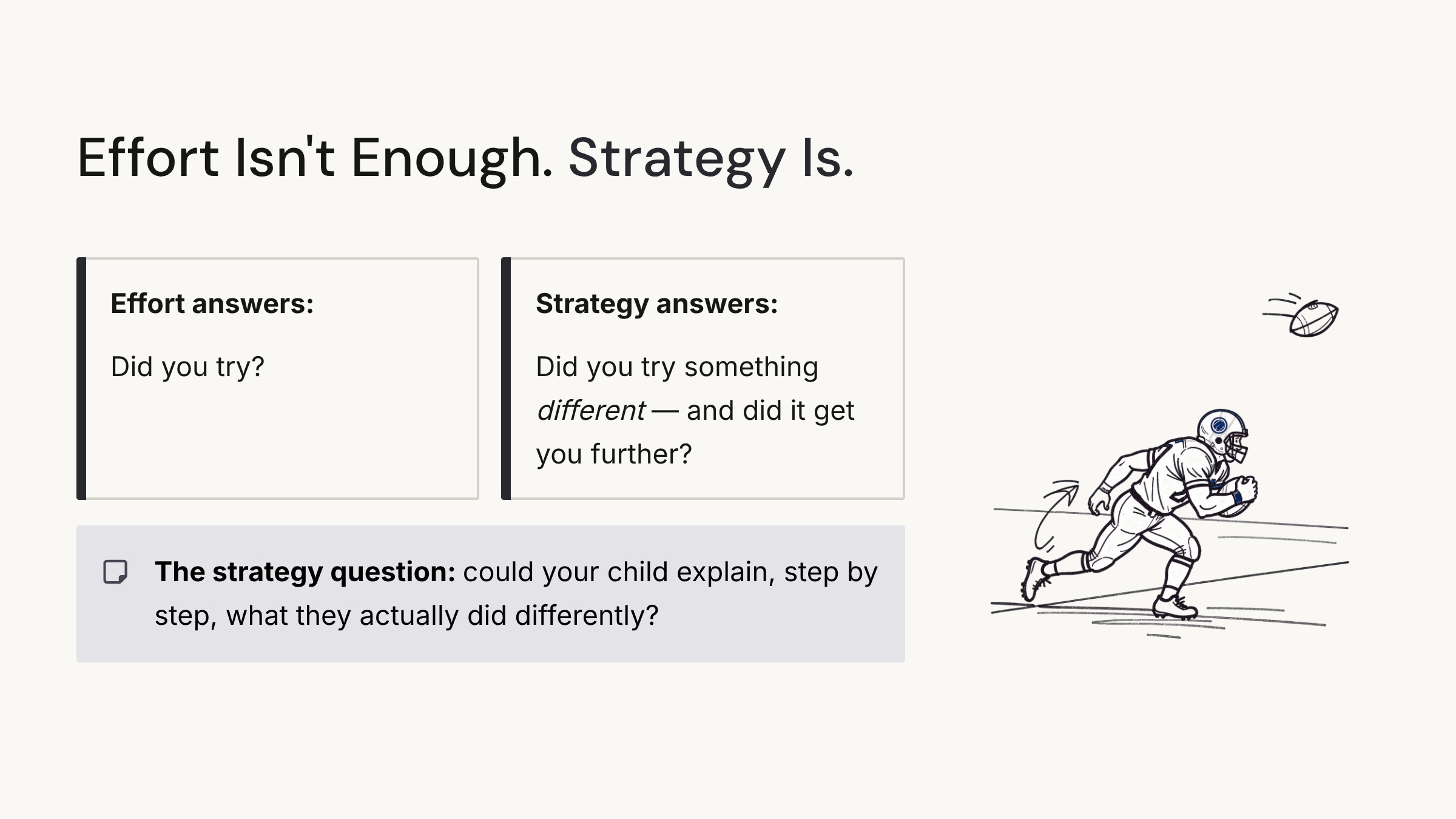
The part that actually changes something isn’t effort. It’s strategy — the specific thing your child changed between one attempt and the next.
Effort answers one question: did you try? Strategy answers a completely different one: did you try something different, and did it get you further than last time? Those are not the same question, and only one of them produces improvement. A kid can max out effort and get nowhere, forever, if the approach underneath the effort never shifts. My daughter reading the same four words the same way for the fifth night in a row wasn’t lacking effort. She was lacking a new move.
This is the piece most of us skip, because it’s slower. “You worked so hard” takes four seconds and ends the conversation. “What did you do differently this time, and did it help?” takes an actual back-and-forth — one where you might not like the answer, because the honest answer is often nothing changed. That’s an uncomfortable thing to sit with as a parent, because it means the warm, encouraging thing you were about to say isn’t actually true yet. Saying it anyway is the whole trap.
There’s a useful filter here, one I’ve started running silently before I open my mouth. Call it the strategy question: before praising effort, ask yourself what your child would say if you asked them to explain, step by step, what they actually did. If they can answer with something specific — “I covered the answer and tried to say it before checking,” “I did the hard problems first while I still had energy” — the effort is real and worth naming precisely. If the honest answer is “I just, like, did it again” — that’s not effort in the sense that builds anything. That’s motion without a strategy attached, and no amount of praise turns motion into progress.
This shows up everywhere once you start looking for it, not just in schoolwork. My son plays weekend football, and after a loss last season I caught myself saying the exact same hollow line: “You worked so hard out there.” He’d run himself into the ground chasing the same ball down the same wing all game, getting beaten the same way every time. The effort was real. It was also, on its own, worthless — because nothing about how he was defending had changed from the first half to the second. What actually would have helped was the harder question: what did the winger keep doing that worked, and what’s one thing you’d try differently next time you’re in that position? That’s a different conversation than “great hustle.” It’s also the only one that makes the next game better than this one.
What this looks like in practice
That night with the spelling words, instead of praising the effort again, I asked her the boring, useful question: “Walk me through how you studied these four.” She said she read them, over and over. Same as every night. So we tried something else — she wrote each word wrong on purpose, then crossed it out and wrote it correctly right next to it. Three minutes. Two days later: all four, correct.
I didn’t tell her she was smart. I didn’t tell her she tried hard. I told her, “You changed what you were doing, and it worked.” That’s the sentence that actually builds something — because it’s specific, it’s true, and it hands her something she can reuse next time she’s stuck on anything, not just spelling.
The shift isn’t complicated once you see it, but it does require giving up the fast, warm, easy line. Instead of “I’m proud of how hard you tried,” try “What’s one thing you did differently this time?” Instead of “great effort,” try “what worked, and what didn’t?” The second version takes longer to say and doesn’t feel as encouraging in the moment. It’s also the only version that’s actually true to what growth mindset was supposed to mean in the first place — not effort for its own sake, but effort that learns.
The bridge
Thursday, I’m sharing with you the exact conversation for the moment my daughter’s spelling test created — the script for when your child’s effort clearly didn’t work, and “good try” is the last thing they need to hear. Word for word, ages 5 through teenager, including what to do when they get defensive about the strategy question, and how to ask it without it sounding like criticism dressed up as a quiz.
Before then, one for you to sit with: the last time you told your child you were proud of how hard they worked — were you praising the effort, or were you quietly avoiding the harder conversation about whether it worked at all?