
The Question My Son Asked That I Couldn't Answer — And Why That Scared Me More Than It Should Have
Critical Thinking — the skill the World Economic Forum calls the #1 core competency for 2030, and the one most kids are never actually taught

My teenage son came home from school last year with an assignment on climate change. He’d done it thoroughly — three pages, well-structured, good sources cited. I read it over dinner and asked him one question:
“How did you decide which sources to trust?”
He looked at me. “They were on the list the teacher gave us.”
I nodded. “And if the list wasn’t there? How would you have figured out which ones to believe?”
The silence that followed wasn’t the silence of someone thinking. It was the silence of someone who’d never been asked to think about that before.
He’s a bright kid. He works hard, gets good marks, asks intelligent questions in class. But in that moment I realised something that stopped me cold: he’d spent nine years in school learning to find the right answer. Not once had he been explicitly taught how to evaluate whether an answer was right in the first place.
That’s a very different skill. And it’s the one our children are going to need most.
What School Teaches vs. What Critical Thinking Actually Is
Here’s the tension at the heart of this week’s post.
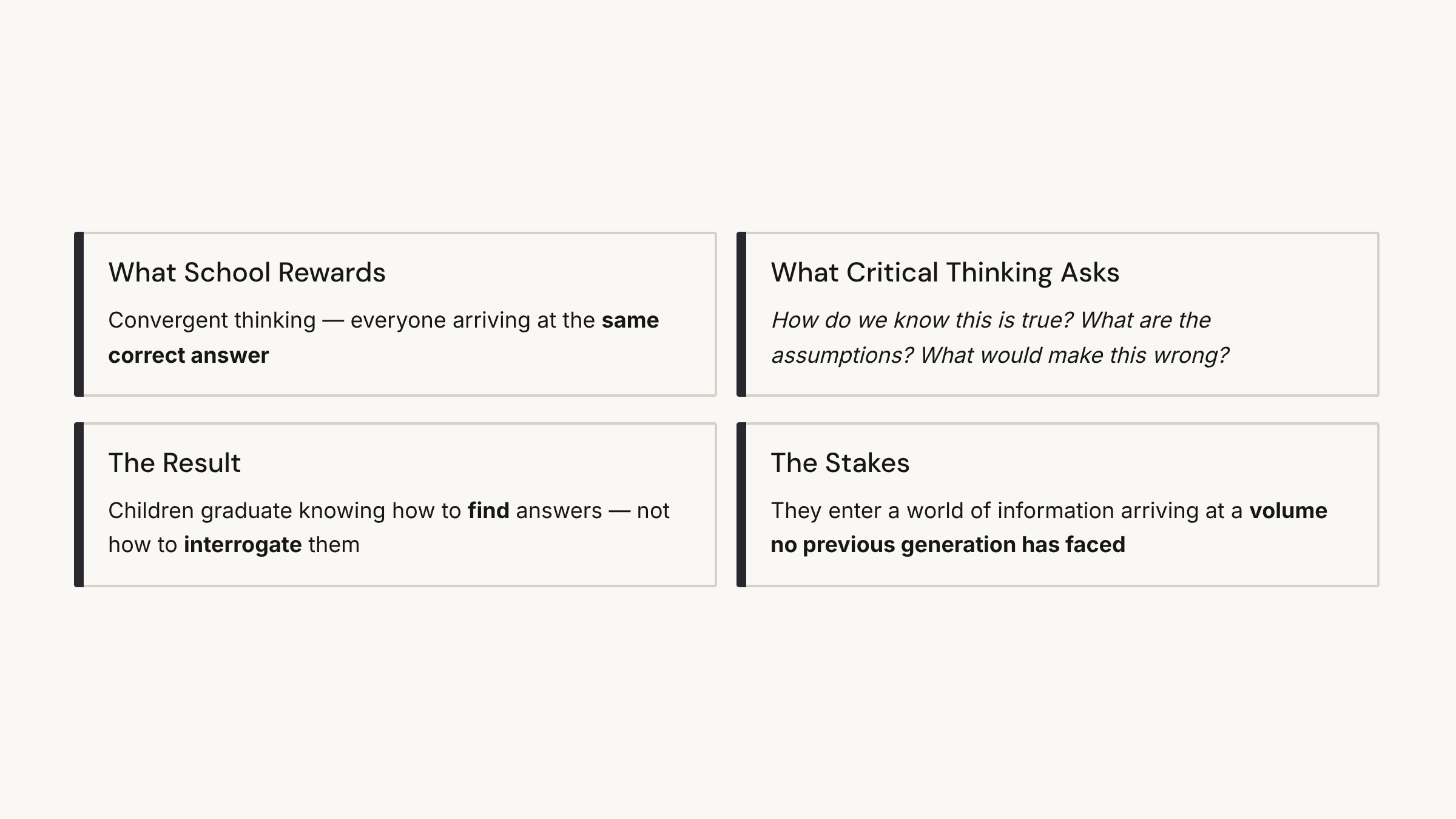
School, as it’s currently structured, is extraordinarily good at teaching children to process and reproduce information. Read this. Understand it. Show us you understood it. Repeat. The system rewards students who can accurately return what they were given — and that’s not a criticism of teachers, most of whom would love to teach differently. It’s a structural reality. When you’re covering a curriculum and assessing thirty students against standardised benchmarks, convergent thinking — everyone arriving at the same correct answer — is what the system is built for.
Critical thinking is divergent by nature. It asks: How do we know this is true? What’s the evidence? What are the assumptions buried in this claim? What would have to be different for this to be wrong? These questions don’t have a single correct answer you can mark on a rubric. They produce productive disagreement. They slow things down. In a system optimised for throughput, they’re inconvenient.
The result is that most children graduate school having absorbed an enormous amount of information and having almost no formal practice in questioning it. They know how to find answers. They don’t know how to interrogate them.
And the world they’re walking into is one where information — accurate, inaccurate, manipulated, well-intentioned, and deliberately misleading — arrives at a volume and velocity that no previous generation has ever faced.
Why This Is Now the Most Urgent Skill on the List
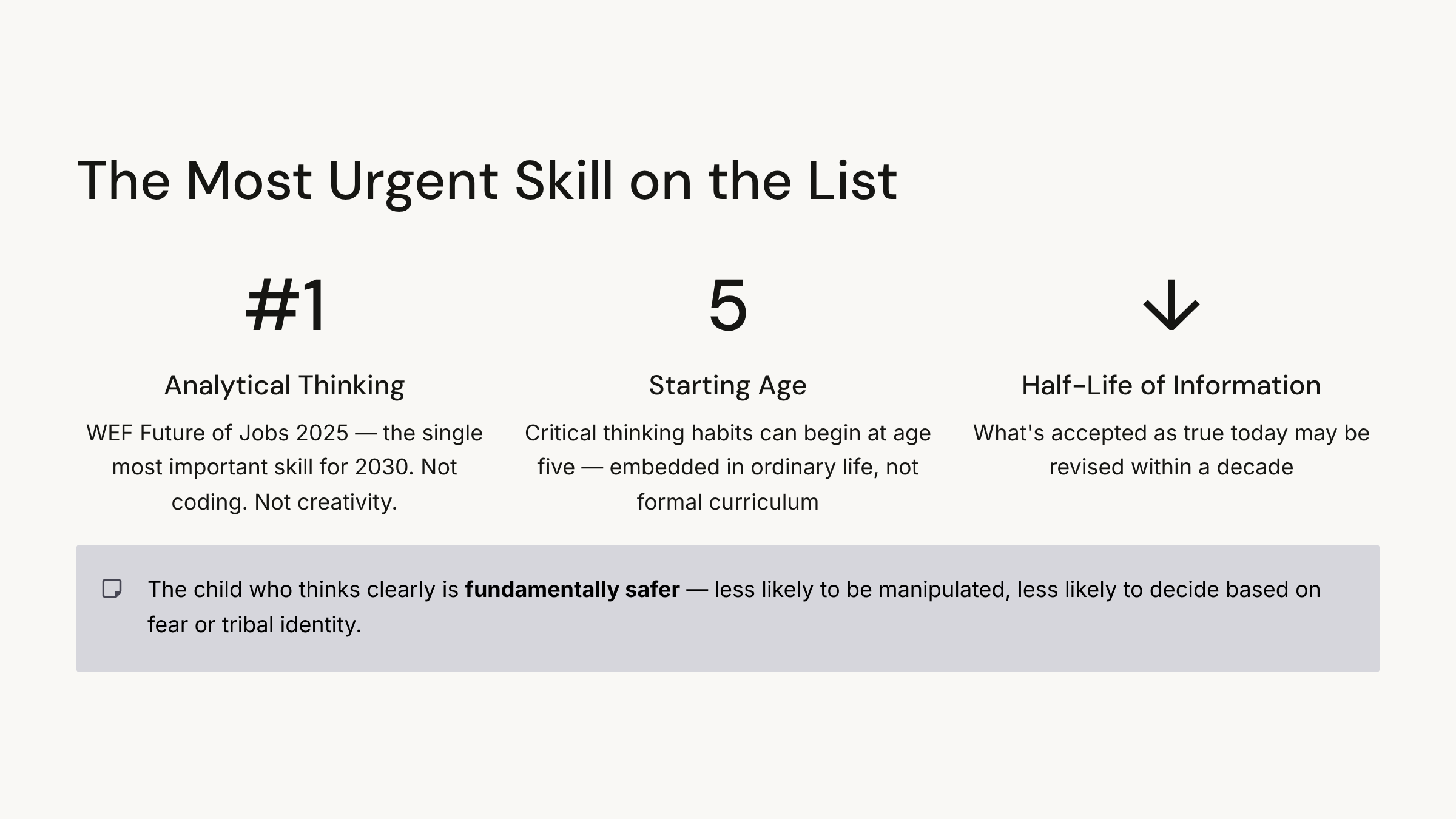
The World Economic Forum’s Future of Jobs Report 2025 ranked analytical thinking as the single most important skill for 2030. Not coding. Not communication. Not even creativity. The ability to reason carefully, evaluate evidence, and reach independent conclusions.
That ranking isn’t arbitrary. The WEF is looking at a world where AI can generate a convincing-sounding argument for almost any position, where social media algorithms reward emotional certainty over factual accuracy, and where the half-life of information is shrinking — what is accepted as true in a field today may be revised or overturned within a decade.
In that world, the child who can think clearly under pressure is not just academically better off. They are fundamentally safer. Less likely to be manipulated. Less likely to make decisions based on fear, tribal identity, or whoever spoke to them most recently. More likely to change their mind when the evidence actually warrants it — which is rarer than it sounds.
Here’s the part that should give every parent pause: this skill doesn’t develop automatically. It doesn’t emerge from reading enough books or watching enough documentaries or having intelligent conversations at dinner, though all of those help. Critical thinking is a set of specific, learnable habits — and like all habits, they have to be practised deliberately, over time, with enough repetition that they become the default response rather than the effortful one.
The good news — and this is genuinely good news — is that those habits can start at age five. Not in a formal, curriculum-style way. In the way that all the best skill-building happens: embedded in ordinary life, through questions that feel like curiosity rather than homework.
The Mistake We Make When We Try to Teach It
When most parents hear “critical thinking” they immediately think of two things: debate, and devil’s advocate. They imagine sitting their child down and challenging every statement they make. Playing the opposition. Stress-testing their reasoning until they can defend a position under pressure.
This approach fails with most children — and it fails in a very specific way. Children who are repeatedly challenged on their views by a parent don’t learn to think more critically. They learn to hold their views more privately. They stop sharing opinions that might be interrogated. They become less willing to voice uncertainty, because uncertainty gets challenged too. What looks like critical thinking practice is actually teaching them to armour up.
Real critical thinking starts somewhere gentler. It starts with a question that’s genuinely curious rather than adversarial. The difference between “Why do you think that?” asked with warmth and “Why do you think that?” asked with challenge is not subtle — children read it in a millisecond, and it changes everything about how they respond.
The entry point isn’t argument. It’s wonder. “Huh, I hadn’t thought about it that way. How did you get to that?” That single question, asked with genuine interest, does more for a child’s reasoning habits than an hour of structured debate. It signals that their thinking process is worth examining — not because it’s wrong, but because thinking is interesting.
From that foundation, everything else builds.
Three Things to Try This Week
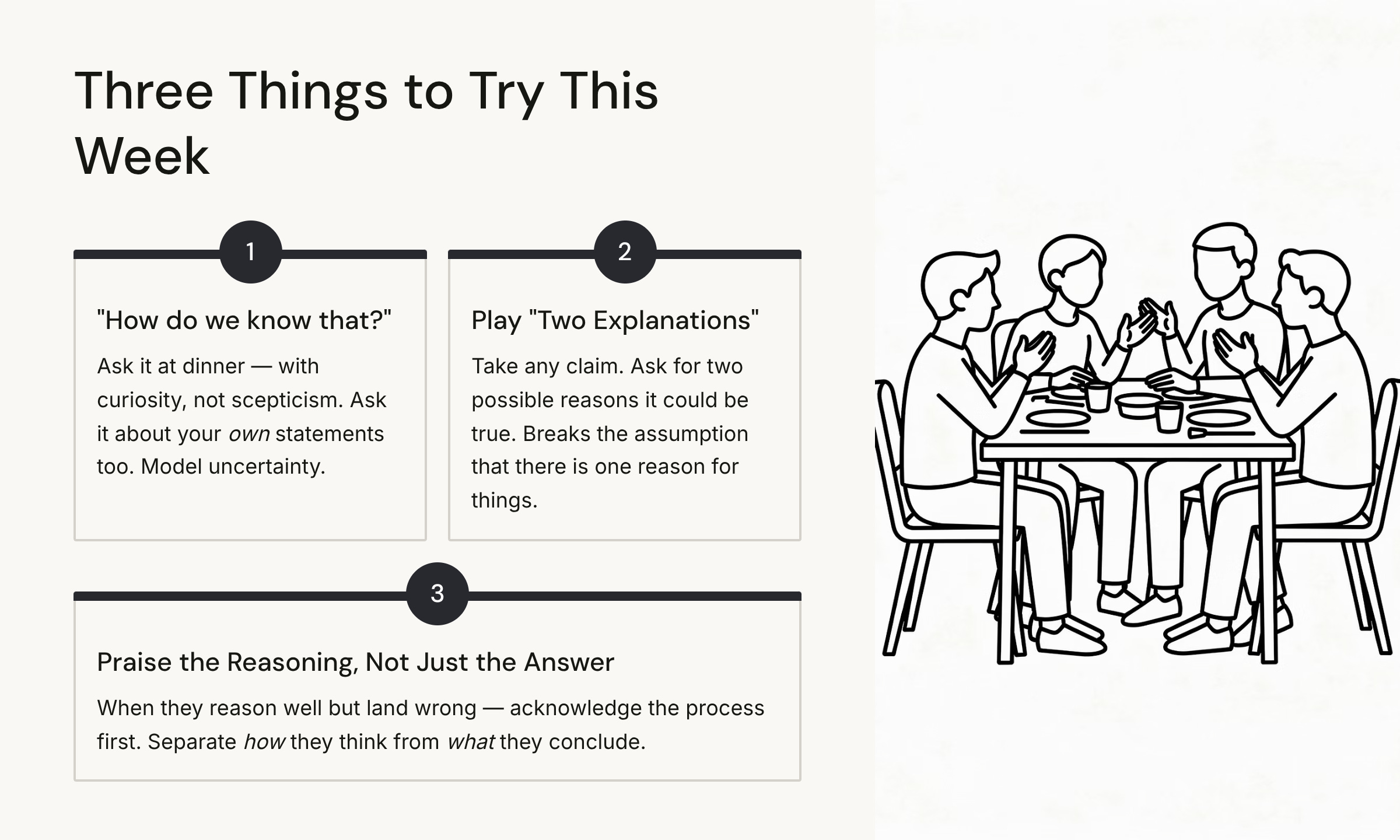
Step 1: Introduce “How do we know that?” as a family question — not a challenge.
This week, when something comes up at dinner — a news story, something a child heard at school, a claim from an advertisement, a fact they read somewhere — try asking “How do we know that?” with genuine curiosity rather than scepticism. Not “Is that actually true?” (which carries an implied challenge) but “How would someone figure that out? What’s the evidence?”
Ages 5–7: Keep it concrete. “How did scientists find out that dinosaurs were real? They weren’t there to see them.” This is age-appropriate critical thinking — exploring how knowledge gets established, not whether the knowledge is wrong.
Ages 8–10: “Where did you hear that? Do you think that source would know? How would they have found out?” Teach the chain of evidence, not just the conclusion.
Ages 11–12: “What would someone have to believe for that argument to make sense? Do you think that’s actually true?” This moves them into assumption-examination, which is the core of analytical thinking.
The rule: ask it about your own statements too. Model uncertainty. “I just said that with a lot of confidence. Actually, I’m not completely sure how I know that. Let’s check.”
Step 2: Play “Two Explanations” once this week.
Pick any claim — from the news, from school, from a conversation. Something your child encountered this week. Ask them to come up with two possible explanations for why that claim might be true. Not whether it is true — just two different explanations for how it could have come to be.
This does something that is surprisingly hard for children (and adults): it breaks the assumption that there is one reason for things. Most children, when presented with a claim, immediately accept or reject it. Two Explanations forces them to hold multiple possibilities simultaneously — which is the cognitive foundation of genuine critical thinking.
Ages 5–7: “Our neighbour said it’s going to rain tomorrow. What are two different reasons she might think that?” (She looked at the sky. She checked her phone.) Simple, concrete, but genuine reasoning practice.
Ages 8–10: “This article says kids who play sport do better at school. What are two different explanations for why that might be true?” (Sport builds focus. Or maybe — kids who are already more organised do both sport and study.)
Ages 11–12: “Someone shared this on social media and it got thousands of likes. What are two different explanations for why something gets shared a lot — that have nothing to do with whether it’s true?” Watch what happens.
Step 3: Let your child be right when they’ve reasoned well — even if the conclusion is wrong.
This one is counterintuitive and important. When your child works through a problem carefully, examines evidence, considers alternatives, and reaches a conclusion — and the conclusion is factually incorrect — resist the urge to immediately correct the conclusion. Instead, acknowledge the reasoning first. “That was really solid thinking. You looked at it from two angles and you made a logical connection. The conclusion actually turns out to be different — but the way you got there was exactly right.”
This sounds like a small thing. It isn’t. Most children receive feedback on whether their answer is correct, not on whether their reasoning was sound. When you consistently separate those two things — praising careful reasoning independently of accurate conclusions — you teach them that how they think matters, not just what they arrive at. That single shift, sustained over years, is what produces a child who can think independently when you’re not in the room.
When my son couldn’t tell me how he’d evaluate a source without a teacher’s list, I didn’t panic. But I did pay attention. That’s the gap we’re working on now — not arguing, not debate practice, not formal logic. Just a habit of asking one more question before accepting something as settled.
He’s getting there. Last week he came home and told me unprompted that a claim circulating in his friend group “didn’t make sense because the numbers didn’t add up.” He couldn’t articulate why he knew to check the numbers. But he checked them.
That’s the thing taking root. It doesn’t announce itself. It just quietly becomes part of how they move through the world.
Together, we’re raising kids who don’t just know what to think — they know how to think. In a world that’s working very hard to do their thinking for them, that’s the most protective skill we can give them.
See you Wednesday.
Paid subscribers: Wednesday’s implementation guide goes deep on the Critical Thinking Framework — the four questions to use at every age, how to navigate the child who accepts everything they’re told, and a practical toolkit for building evidence-evaluation as a daily habit. Friday’s action plan gives you the complete system: age-by-age scripts, real-world scenarios to practise with, and a 30-day challenge built around the one skill the WEF says matters most.
Very thoughtful and practical. I appreciate you thoroughness and age differentiated activities.