
The Thing We Do That Makes Failure Worse

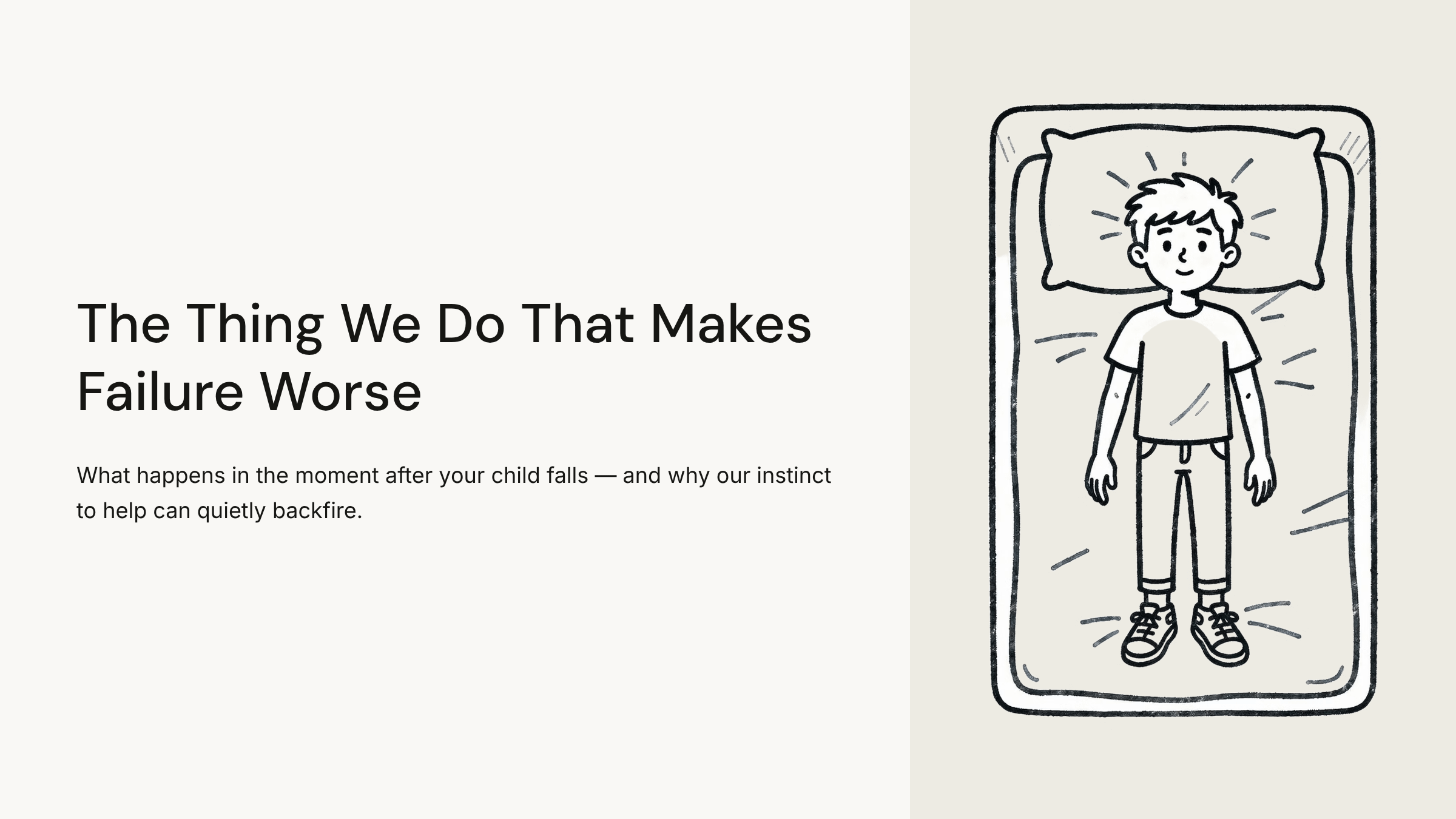
My son came home from school and went straight to his room.
No bag dropped at the door. No raid on the fridge. Just the quiet click of a door closing — the specific kind of quiet that means something happened.
I waited twenty minutes before knocking. When I went in, he was lying on his bed staring at the ceiling, still in his school shoes. The laces still tied. That detail got me — he hadn’t even sat down properly. He’d just fallen backwards onto the bed and stayed there.
“I didn’t make the team,” he said.
He’d been training for the soccer trials for six weeks. Early mornings before school. A YouTube rabbit hole of dribbling drills he’d found himself. He’d asked me to time him on the back lawn with my phone — more than once, more than twice. He had a notebook where he’d written down things he wanted to improve. An actual notebook, unprompted, in the handwriting of a fifteen-year-old who does not generally reach for notebooks.
He didn’t make the squad. And now he was on his bed at 4pm with his shoes still on, and I had approximately three seconds to decide what kind of parent I was going to be in this moment.
My instinct — the one that fired immediately and felt completely like love — was to fix it.
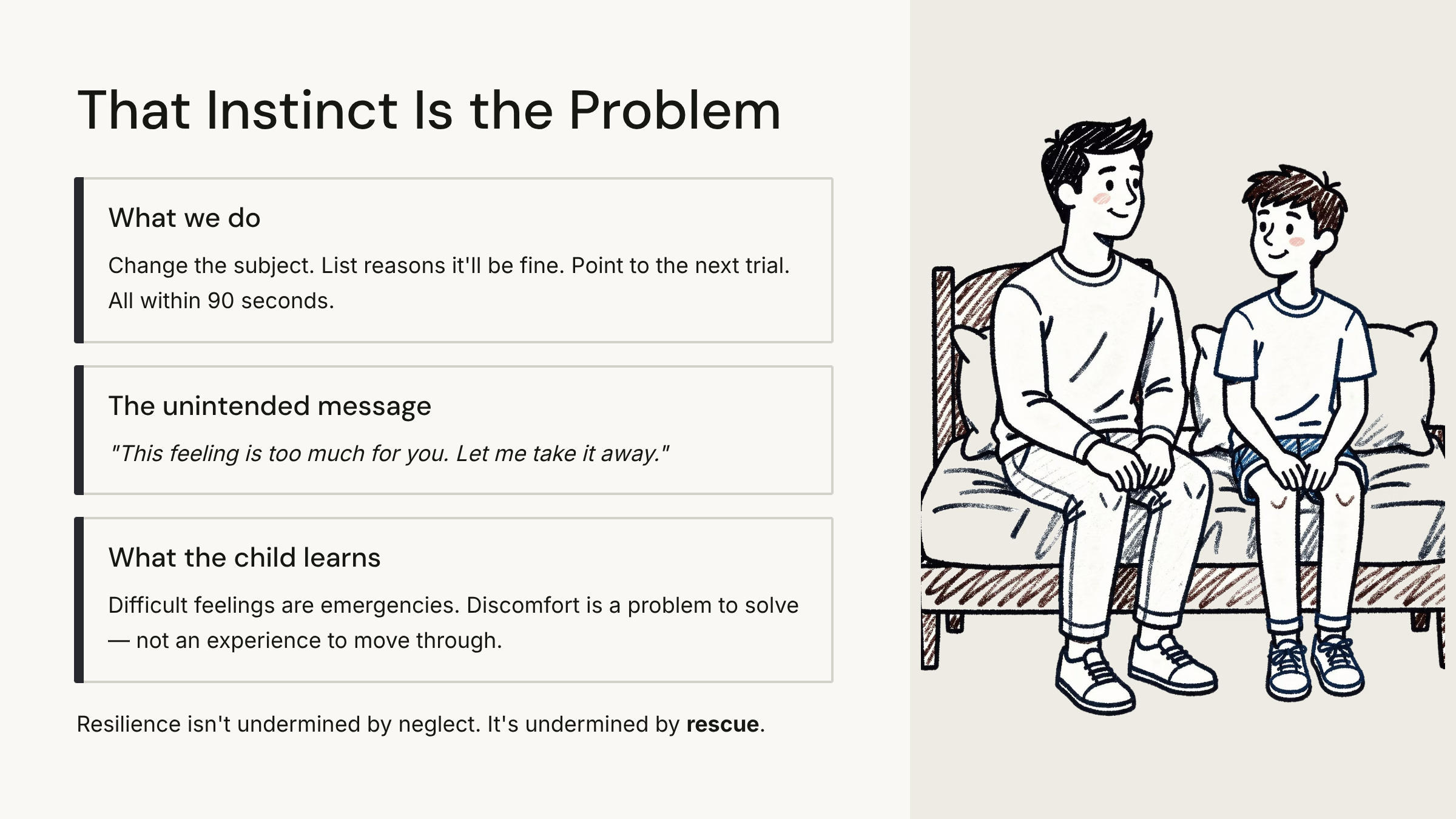
That instinct is the problem.
Not because it’s wrong to care. But because the moment we move to fix a child’s pain, we accidentally send them a message we never intended to send.
This feeling is too much for you to sit with. Let me take it away.
We say it without words. We say it by changing the subject, by listing all the reasons it will be fine, by pointing out the next trial date, by reminding them of everything they’re good at — all within the first ninety seconds. We do it because we love them and because their pain is genuinely hard to watch. We do it because staying still in the presence of someone else’s distress is one of the most difficult things a human being can do.
And the child learns something. Not that they’re loved — they already knew that. They learn that difficult feelings are emergencies. That discomfort is a problem to be solved, not an experience to be moved through.
This is how well-meaning parents raise children who cannot tolerate frustration. Not through neglect. Through rescue. The two look nothing alike from the outside. From the inside, the effect on the child is surprisingly similar.
Resilience is not what most parents think it is.
We tend to imagine it as toughness — the ability to bounce back quickly, to shrug things off, to move on. We quietly admire the child who doesn’t cry. We worry about the one who takes things hard and needs more time.
But the research tells a completely different story.
Resilience is not the speed of recovery. It is the experience of recovery. A child becomes resilient not by avoiding difficulty but by moving through it — and arriving on the other side intact. Each time they do, something accumulates. A kind of internal evidence. I’ve been here before. I got through it. I can again.
The child who never sits with difficulty never builds that evidence base. They reach adolescence — and eventually adulthood — genuinely unsure whether they can cope, because they’ve never been allowed to find out. Every hard moment was intercepted before it could teach them anything.
And here’s what makes this particularly uncomfortable to sit with as a parent: the more capable and caring we are, the more likely we are to intercept. The parents who most want to raise resilient children are often the ones most tempted to rescue — because they’re paying close attention, and they’re good at solving problems, and they love their kids intensely.
None of that is a character flaw. But it is worth noticing.
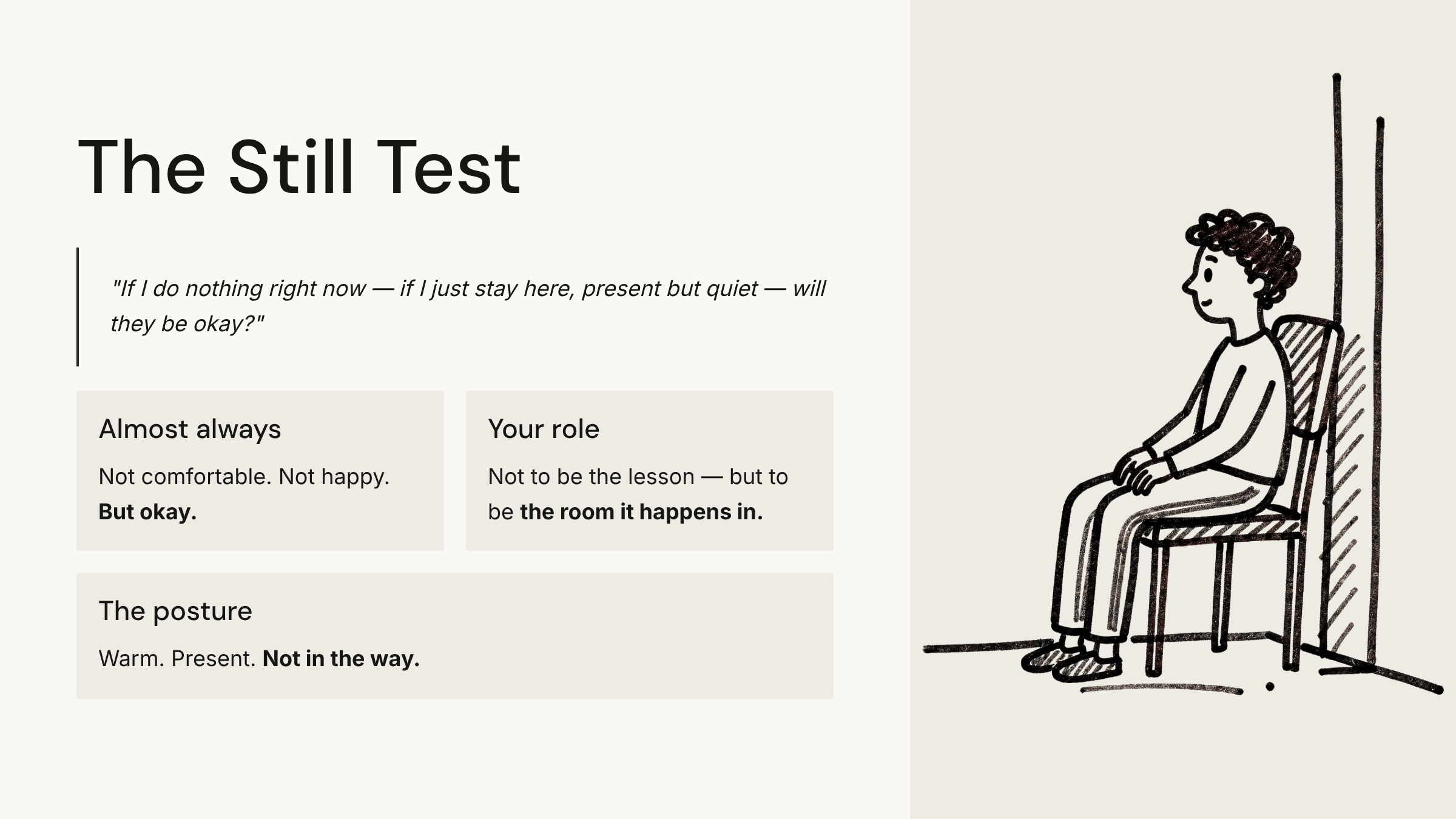
The Still Test is what I now try to run before I respond to my kids in these moments.
It’s simple: If I do nothing right now — if I just stay here, present but quiet — will they be okay?
Almost always, the answer is yes. Not comfortable. Not happy. But okay.
The test isn’t about abandonment or emotional unavailability. It’s about resisting the reflex to intervene before the child has had a chance to feel their own way through. It’s about trusting that the discomfort has something to teach, and that your job in this moment is not to be the lesson — but to be the room it happens in.
Warm. Present. Not in the way.
Here’s what it looked like in practice.
I sat on the end of the bed. I didn’t say anything for a while. He didn’t either.
Eventually I said: “That’s a gutting thing to find out.”
He didn’t respond. I didn’t try again. We sat there for a few more minutes. Then I told him dinner would be in about an hour and left the door open on the way out.
Later — maybe half an hour — he came out and asked if we could watch the match that was on. Not fixed. Not over it. But through the worst of it, on his own terms, with me nearby rather than in the way.
Two days later, unprompted, he said: “I think I need to work on my left foot.”
That sentence is what resilience actually looks like. Not the bounce. The return. The quiet, self-directed decision to re-engage — made without anyone pushing him toward it. That only happens when a child has been given enough space to arrive there themselves.
You can’t hand them that sentence. You can only stay out of the way long enough for them to find it.
Thursday’s post is the practical side of all of this.
It’s a word-for-word conversation guide — what to say when your child comes home deflated, what to do when they go quiet, and how to adjust the approach depending on whether you’re dealing with a six-year-old or a twelve-year-old. Because the same principle looks different at different ages, and the instinct to rescue is strongest precisely when the stakes feel highest.
The moments that matter most in parenting tend to arrive without warning. Thursday will help you be ready for the next one.
Before then — think about the last time your child struggled with something hard. What was your first instinct? And what do you think they actually needed from you in that moment?
This is one of the hardest parts about parenting. One thing I did often when my boys were young was just to sit next to them on the bed and use my finger to draw a big heart shape on their back, and I just keep doing it until they feel ready to talk about it. It was a way for me to let them know, it’s safe to feel their feelings while this gentle touch offers some comfort that words can’t express.